
Sources for Tracing Former Jasper County Owners
Former owners of a Jasper County property emerge from a chain of deeds. They never come from a single owner list. The recorder's books hold the sequence. Begin with the newest deed reference and work backward, conveyance by conveyance. For older eras, plats, tax-forfeiture files, court records, and archival collections can name the land and its people. These sources help when a modern address did not yet exist.
| Source | Years It Covers | Where Held | What It Shows |
|---|---|---|---|
| Direct and reverse deed indexes | Coverage year not published | Jasper Chancery Clerk | Grantors, grantees and recording references |
| Deed books and sectional indexes | Historic through current holdings | Paulding or Bay Springs office | Earlier transfers and rural tract keys |
| Map/Plat Book | Dates vary by recorded plat | Chancery Clerk | Subdivision, lot and unit identity |
| MDAH Jasper records | Court records from 1834; tax-forfeiture material from 1852 | Mississippi archives | Older land events, forfeitures and redemptions |
The clerk's deed chain handles ordinary transfers. A plat works better when lot identity changed. Estate, forfeiture, or court records bridge the gaps.
Open the MDAH Jasper County finding aid that supports this archive view.
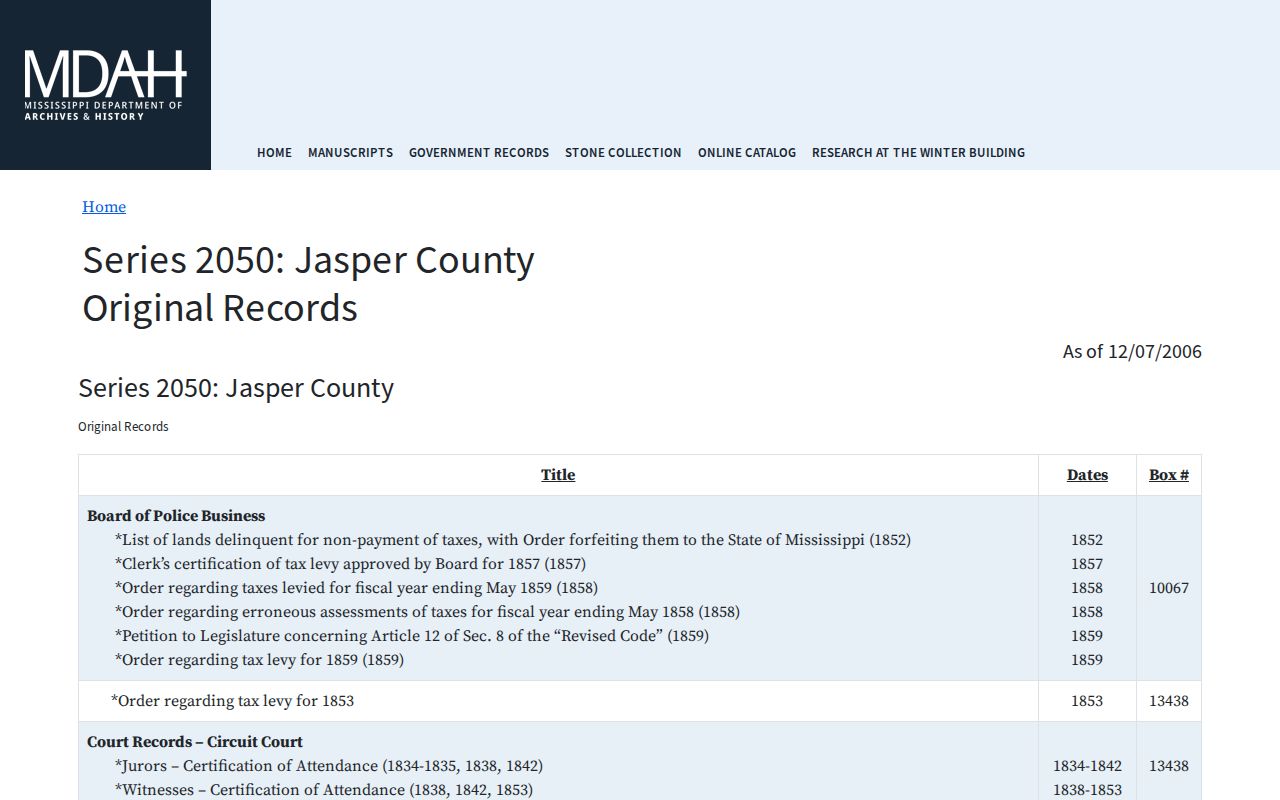
An MDAH finding aid adds historical depth to a former-owner search. It points to an archival series before material gets requested. The tract and event still need to match the deed timeline.
Start a Jasper Former-Owner History with the Latest Grantee
The current parcel is only the entry point. The public Jasper MS Parcel Viewer can show owner name, PPIN, parcel ID, legal description, and the deed book, page, and date in its layer. Save all of it. That deed reference leads to the current vesting instrument. The legal description keeps the search anchored to the same land.
Map data can lag or carry errors, so confirm the deed at the Chancery Clerk. The latest sale may be too recent for the parcel layer. In that case, the clerk's record may run ahead of the tax roll. The separate current owner guide covers the present snapshot. This page uses that snapshot only to start the backward chain.
Jasper's Former Owners Have No Published Online Deed Cutoff
Jasper County publishes no public Chancery land-record portal. The Land Title Association of Mississippi directory shows no online availability for the county. So no "online since" year exists to cite. The chain must be searched at the courthouse or through a clerk request. That says nothing about when the records themselves begin.
This limitation rewards preparation. Call the Chancery Clerk with the district, names, approximate dates, book and page. You can also give the section-township-range, or the subdivision and lot. Ask which index or book fits the request before sending a fee.
Walk Jasper County's Prior-Owner Deed Chain in Reverse
Treat each deed as one link. The newest grantee is the name you use to find a purchase. That deed's grantor becomes the former owner and the next search target. Track the exact land description at every step.
- Confirm the newest vesting deed with the present owner shown as grantee.
- Copy its grantor, recording date, book, page and full legal description.
- Find that grantor's earlier acquisition with the person shown as grantee.
- Repeat in the reverse index and older deed books, checking the land identity each time.
- Grantor / grantee
- The conveying party and receiving party named in an instrument.
- Chain of title
- The ordered succession of transfers affecting the same land.
- Legal description
- The land identity that survives road-name and mailing-address changes.
Legal Descriptions Keep Jasper's Past Owners on Track
A surname can repeat, change spelling, or hide behind initials, a trust, or an estate. Addresses shift or vanish entirely. Jasper's GIS uses quarter-section shorthand like E2 NE NE. Subdivision records lean on lot, block, or unit language. Sectional and map or plat indexes offer alternate routes when names fail.
One parcel carried a mailing address. Its situs value was "0 UNADDRESSED." That is a concrete warning against chaining prior owners by address alone. Compare acreage, adjoining references, section-township-range, and plat language before accepting the next historic link.
Estate Files Can Bridge a Broken Jasper Former-Owner Chain
Land does not always pass by ordinary sale. Probate, heirship, partition, a commissioner's sale, or a trustee can carry it instead. Jasper's Chancery Clerk keeps chancery dockets, will books, and probate or estate records. Search the deceased owner's estate and the receiving heirs when the deed sequence skips a generation.
Mississippi Electronic Courts lists Jasper chancery locations from July 22, 2019, but access is account based. Older or restricted material stays with the clerk. A docket can point to an order or estate authority. The resulting deed or conveyance remains the link worth recording in the property timeline.
Mineral Assignments May Tell a Different Jasper Ownership Story
Jasper's land indexes and fee schedule specifically cover oil and gas leases. They also cover mineral deeds, royalty deeds, and related assignments and releases. These documents can split a subsurface interest from surface ownership. A name in a mineral instrument was not necessarily a former owner of the whole parcel.
Label the interest being followed. Build one sequence for fee or surface conveyances. Build another, when relevant, for mineral or royalty rights. Read releases and assignments so an old recorded lease is not mistaken for an active claim.
Jasper's 1852 Records Add Depth to Former-Owner Research
The Mississippi Department of Archives and History identifies Jasper court material from 1834. It also identifies delinquent-land or tax-forfeiture records from 1852. Those sources may reveal a sheriff's sale, redemption, or levy. That could explain why the next deed names an unexpected seller. Treat them as clues, not substitutes for matching the tract.
The Jasper County archival finding aid helps identify relevant series. Historic newspapers add sale notices too. The True Democrat's Paulding issues ran from 1845 to 1847. They may support property-history or heir research once a name and approximate event are known.
Plats Reconnect Jasper Lots Across Generations
Bay Springs was first platted on September 12, 1901. The original plat covered 173 acres. That recorded plat still anchors the land. Jasper GIS legal text also refers to the same land as "Lake Eddins S/D." Unit references and mailing geographies vary under that name. Labels shift, but the plat does not. Work from the old subdivision name or the modern parcel framework. Either way, the plat ties a historic lot to land you can locate today.
Ask for the Map/Plat Book reference. Compare lot, unit, road, and any later replat details side by side. A ZIP code or postal city proves nothing about municipal limits. A subdivision label does not establish ownership either. Every prior owner still requires a deed or legally effective transfer tied to the same platted land.
Build a Verifiable Jasper Former-Owner Timeline
Structure the log with one row per event. Record the recording date and the effective date when it differs. Note the grantor, grantee, instrument type, and book and page. Add the legal-description match, the district, and any unresolved issue. Estate orders, tax deeds, and plat changes belong in the same log. Keep them as their own event types, never merged into ordinary sales. Laid out this way, overlaps and missing links stand out quickly.
For copies, Jasper's posted schedule splits the fees three ways. Clerk-made copies run $0.50 per page. Copies made by others run $0.25 per page, and certified complete documents are $1 each. The sheet was posted in 2025 but lists an effective date of January 1, 2020. Confirm current charges before paying. The deed records page covers copy-request details.
How Far Back Jasper County Ownership Research Can Reach
Jasper County was formed in 1833. Archival descriptions reach into the decades right after that. No official source, though, publishes a single universal earliest deed date or a complete coverage statement for the county. The honest answer is source by source. Follow the Chancery deed books and indexes as far as they genuinely support your tract, then test earlier ownership against patents, plats, court records, probate files, and tax-forfeiture materials.
A chain ends where the evidence ends. It does not end at an assumed web cutoff. Keep citations intact, and keep a confirmed owner of record distinct from someone merely named in a notice, tax list, or mineral filing. That distinction protects the whole timeline from wishful reading.
Lawful use. Research previous owners for title questions, property history, inheritance and purchase diligence. Never use historic or current owner information to stalk, harass or harm a living person.